logo
Contact Dr. Sowder

A ^Retired Plastic Surgeon's Notebook

Tag: board certified plastic surgeon


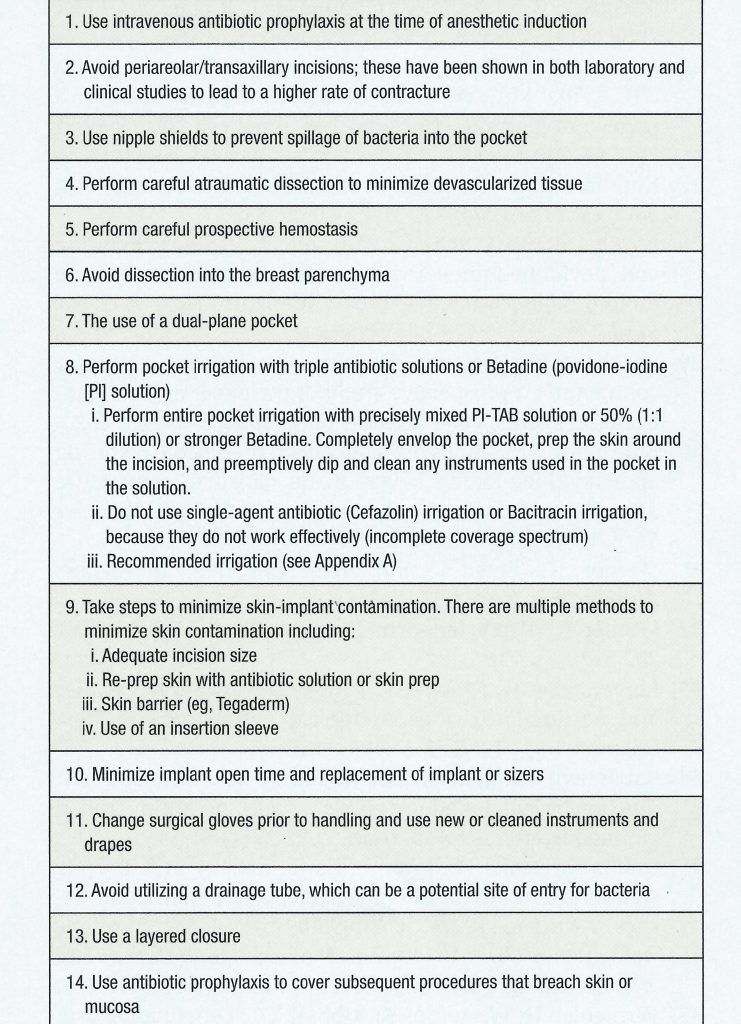
14-Point Plan for Breast Implant Placement

June 26th, 2018 — 1:53pm

Surgical techniques are constantly evolving and breast implant technique is no exception.  In the past couple of years recommendations to minimize implant and implant pocket contamination have been developed.  This is in response to overwhelming evidence that bacterial contamination is the main cause of capsular contracture and may also be the cause of breast implant associated anaplastic large cell lymphoma (BIA-ALCL).   Both of these conditions have been linked to the presence of biofilm around the breast implants.  Biofilm is the product of certain bacteria, Staph epidermidis in the case of capsular contracture and Ralstonia piketti in the case of BIA-ALCL.  It is our hope that with the adoption of the Surgical 14-Point Plan for Breast Implant Placement the annoying and difficult problem of capsular contracture and very serious and potentially fatal problem of BIA-ALCL will drop in frequency.  If you are planning on breast implant surgery, you should ask your surgeon if he/she uses the 14 point plan.  They should!

Surgical 14-Point Plan for Breast Implant Placement, from Aesthetic Surgery Journal, 2018, Vol38(6) page 625

Thanks for reading and I would be honored if you followed me on Instagram @sowdermd and @breastimplantsanity.  Dr. Lisa Lynn Sowder

Breast Implants, New Technology

Spectators in the OR

June 18th, 2018 — 10:30am

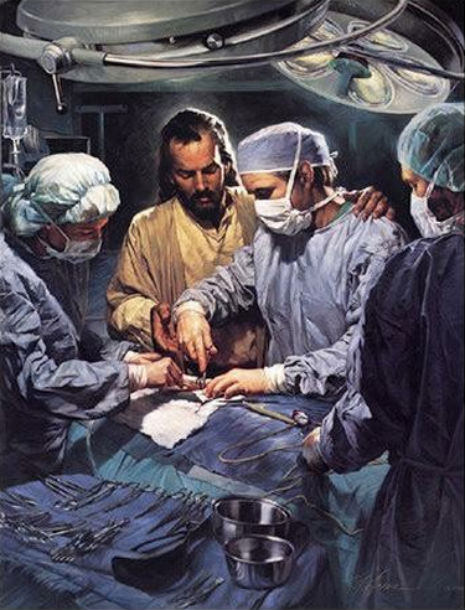
Occasionally I have a request from a patient’s friend or family member to come into the OR to “watch the surgery.”  Many times they tell me that they have seen it on T.V. or on YouTube and just think it will be cool to see it in person.  The answer is always no and here is why.  In the OR, what may look like a relaxed and even fun atmosphere is actually a very carefully planned and executed choreography with several participants front stage and more in the wings.  There is me and the scrub tech at the table and sometimes one of the 6th year plastic surgery residents from the University of Washington.  Then there is the anesthesiologist keeping the patient asleep and safe and then there is the circulating nurse who helps the anesthesiologist and also opens equipment and  supplies as needed.  There really isn’t any extra room for a spectator and that spectator really isn’t going to see much because the surgical field is surrounded on all sides by anesthesia, the Mayo stand with the instruments and people on both sides of the table.  And we keep OR “traffic” to a minimum because of infectious issues.  The more people in and out of the OR the greater chance of contaminating the surgical field.  And a lay person has very little concept of the sterile field and probably has not even heard the term “sterile conscious.”  Don’t take it personally but we surgery types think lay people are just walking talking fomites.

“Jesus Christ! I think you are doing that wrong!”

And then there is “going to ground” factor.  Even the most hardened lay person or even a doctor or nurse may react very differently to the sight of blood when that blood is that of a close friend or a loved one.  If that person goes to ground, then we have another patient to take care of!

I have to tell just one little story about a would be OR spectator from my residency days.  I was rotating at Children’s Hospital in Salt Lake City and doing an infant hernia case with the Chief of Pediatric Surgery, the wonderful Dr. Dale Johnson.  One could not imagine a more competent and kind and ethical surgeon than Dr. Johnson.  He was and even after retirement is a deity in surgery circles.  We scrubbed our hands and arms and went into the OR for gowning and gloving.  He noticed an extra person in the OR with a clipboard. (Surgeon’s have a visceral distrust of people with clipboards).  Dr. Johnson politely asked this lady who she was and why was she here.  She told Dr. Johnson that she was a “patient advocate” there for the patient’s protection.  Dr. Johnson politely asked her from whom she was protecting the patient and if she was going to let him know if he was doing something wrong.  She became flustered and just left the OR and I have never seen or heard of such a “patient advocate” since then.  It was very strange and makes me think if a patient or patient’s parent think they need an advocate in the OR other than their operating surgeon, maybe they should choose another surgeon.

So go ahead and ask to be an observer but just be prepared to hear “no” in the nicest possible way.

Thank you for reading and I would be honored if you followed me on Intragram @sowdermd and @breastimplantsanity.  Dr. Lisa Lynn Sowder

My Plastic Surgery Philosophy, Patient Safety, Plastic Surgery

Got Sunscreen?

June 12th, 2018 — 9:47am

Seattle Plastic Surgeon comments on the results of a long running sunscreen use study from Austrailia. 

90% of this ladies skin aging is due to the sun. I hope her grandson uses sunscreen.

90% of this women’s skin aging is due to the sun. I hope her grandson uses sunscreen.

It’s that time of year when I must nag about tanning.  In rainy Seattle it is so tempting to soak up the sun once summer arrives (that is usually about July 5th).  But please, think before you rip off your clothes, don your thong and grab your beach towel.

A good study published by the Annals of Internal Medicine and reported in the Wall Street Journal  has shown that regular use of sunscreen reduces skin aging by 24%.  It had already been shown many times that sun protection prevents most types of skin cancer but now what seemed to be obvious has also got some scientific cred.   Now my nagging has some scientific backing!

I’m certain we are hardwired to love the feel of photons bombarding our skin but way back when we were being hardwired and learning to walk upright, we would die from an abscessed tooth or a ruptured appendix or (if we were lucky) a quick take down by a leopard long before we developed skin cancer or even a bad case of the wrinkles.

Fortunately, sun protection has finally caught up with our longer life spans.  We have really good sun screens and sun block, protective and comfortable clothing and don’t forget about umbrellas, cabanas and the most lovely shade of all, trees.   And lets hear it for staying indoors when the sun is at it’s strongest.  How about a nice glass of ice tea with some fresh mint leaves and a good book.  May I recommend The Storms of Denali by Nicholas O’Connell, or A Visit from the Goon Squad by Jennifer Egan, or I Remember Nothing by the late and great Norah Ephron?

And just to remind you, I nag because I care.  Thanks for reading.  Dr. Lisa Lynn Sowder

I would be honored if you followed me on Instagram @sowdermd and @breastimplantsanity.

Aging Issues, General Health, Skin Cancer, Skin Care, sun damage

Did you know that I am “Woman of Year in Medicine and Healthcare” and that “Seattle’s #1 Ranked Plastic Surgeon” is not a plastic surgeon?

May 17th, 2018 — 12:20pm

Seattle Plastic Surgeon ponders the meaning of all of these awards than just seem to arrive in the mail along with a place for credit card information.  

Dr. Sowder, you are really are the best.

Dr. Sowder, you are really are the best.

I was dejunking my office this week and came across a bunch of letters and a few emails informing me how fabulous I am and inviting me to order various plaques and trophies (prices range from $99 – $530) so I can spread the news of my fabulousness.

Over the past few years I have been named one of “America’s Top Surgeons”, one of  “America’s Top Plastic Surgeons” (with honors of distinction and excellence), one of the “Leading Physicians of The World”, one of the “Best Doctors in America”, one of “Washington State’s Best Doctors”, “the 2015 Best Business of Seattle in the category of Cosmetic Surgeons”, “One of the 10 Best Plastic Surgeons for Washington”, “Top 100 Health Professionals – 2018”, and (my favorite), “Woman of the Year in Medicine and Healthcare.”

I have to say that I am honored and humbled by all of these accolades but I have a sneaking suspicion that these “associations” really don’t know anything about me or my practice and just want my money.  I’m pretty cheap so you won’t see any this stuff hanging on my wall.

But …………… I am not at all shy about letting the world know about the fabulous awards I actually have received without having to fork over a dime.  Going way, way, way back – here they are, at least the ones I can remember:

  • Tidiest camper at Camp Sweyolaken as a Campfire Girl.  You would laugh at this if you could see my desk right now.
  • Best Book Week Poster – 5th grade, Hutton School, Spokane, Washington (Mom was so proud).
  • First Place Beginner Dog Obediance (shared with Mickey, the wonderdog), Spokane Canine Club.
  • Best Undergraduate Research Paper, University of Washington, 1978 (I got $400 which back then was a boat load of money.  Actually it still is a boat load of money).
  • Phi Beta Kappa – University of Washington, 1978.
  • Alpha Omega Alpha – University of Washington School of Medicine, 1983.
  • Best Paper, Senior Plastic Surgery Residents’ Conference, 1991.
  • Golden Hands Award for the best cosmetic surgery case, Washington Society of Plastic Surgeons, 2005.
  • “The Dom”. a.k.a. best presentation, Northwest Society of Plastic Surgeons, 2009.  It’s called “The Dom” because the prize is a bottle of Dom Perignon.

Oh, and this just in:  There is a new doctor in town who claims on his home page that he is ranked the #1 Plastic Surgeon in Seattle.  And his home page is cluttered with the aforementioned fake plastic surgeon awards.  Problem is that he has not spent one day in an approved plastic surgery residency, is not certified or eligible to be certified by the American Board of Plastic Surgery (the only real plastic surgery board), and is not a member of the American Society of Plastic Surgeons, the American Society for Aesthetic Plastic Surgery, the Washington Society of Plastic Surgeons or the Northwest Society of Plastic Surgeons.  In other words, he is not a plastic surgeon!!!  Is he a good non-plastic surgeon?  Don’t know.  I do know that he is not an honest surgeon.

Thanks for reading and be careful out there when picking a plastic surgeon.  Make sure you pick a real one.  Check your surgeon’s credentials by visiting the American Board of Plastic Surgery 

Thanks for reading, (Multiple Award Winning) Dr. Lisa Lynn Sowder

I would be honored if you followed me on Instagram @sowdermd and @breastimplantsanity.


My Plastic Surgery Philosophy, Now That's a Little Weird, This Makes Me Cranky.

Give me great massage but please hold the b.s.

May 8th, 2018 — 5:22pm


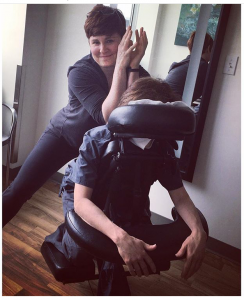
Alison giving the elbow to one of our hard working nurses.

Yesterday we had a wonderful massage therapist come into the office to give our staff 30 minute massages in celebration of Nurses Week.  Oh yeah, I sneaked in and had one too and it was great.  While having my back, neck and shoulders, arms and hands kneaded, pulled, rubbed and elbowed, I had a very nice chat with Alison the therapist.  She is a weight lifter and I had a lot of questions about the mechanics of power lifting, what she thought of body builders, strength training for the over 60 crowd (me, for example), dwarf throwing contests and a bunch of other stuff.  I was so impressed with her knowledge and explanations of how strength isn’t just from muscle bulk but also from neurons in the neuromuscular junction acting in a coordinated fashion, from muscle memory for some actions, from bone strength and angle and from mechanical advantage.  This lady’s b.s. meter was set at zero, just where I like it.

It was particularly nice to have this encounter because a few days earlier there was an article in the Seattle Times about craniosacral therapy which had my b.s. meter red-lining.  Nicole Tsong, who is a yoga instructor, has a nice weekly column about exercise, nutrition and other self care and I usually enjoy reading it.  But this past Sunday, yikes did she go off the rails.  Nicole’s treatment, basically a massage, sounded pretty standard and pleasant but then the therapist started talking nonsense.

Cut and pasted from the article:  Craniosacral therapists observe your cerebrospinal fluid, which moves in roughly eight-, 20- and 100-second cycles, Christman said. My flow was good from my tailbone up until she got to my left shoulder, she said, where the flow contracted. She could work on my connective tissue to help the fluid move, or manipulate the fluid to move back into my shoulder, she said.

Yes, this is a head rub and it feels great but she’s not manipulating your skull and she is not observing your cerebrospinal fluid. Just sayin’.

Christman had asked me before the session about head injuries, and I told her about a concussion I had in college. After working on my spine and pelvis, she moved to my head and started gentle pressure around my skull to manipulate the tissue and bones. I was already relaxed, and when she started to work on my head, I succumbed and closed my eyes, nearly nodding off.

Since this is my blog, I’m just gonna get this off my chest.   Cerebrospinal fluid (CSF from now on) sort of circulates and sloshes around in the ventricles of the brain, between the brain and the skull and in the center of the spinal cord but ………………… 8, 20 and 100 second cycles?  Why not 34 seconds or 82?    Hmmm.  It has been awhile since I took neruoanatomy but that sounds like b.s. to me.  Oh, and the therapist observes the CSF?  I don’t think so.  CSF can be observed when doing a diagnostic spinal tap or doing a spinal anesthetic or during brain or spine surgery or in cases of a skull fracture when CSF can be observed dripping out of ears and nostrils.  Methinks Ms. Christman was not really observing CSF in a therapy session.  But why would she say she was?  Oh, and then CSF in the shoulder?  Nope.  Not there.  There is synovial fluid in the shoulder joint but not CSF.  If you have CSF in your shoulder you should report of the emergency room … stat.

Now lets deconstruct that head rub that Nicole got.  God, I love a good head rub, don’t you?  But I know that a head rub does not manipulate the skull.  The skull does have joints (called sutures) but they fuse in early childhood.  The only way to move a skull around is with power tools and preferably in the OR with a neurosurgeon.

Nicole almost dropped off to sleep and maybe would have been the best way to avoid listening to this balderdash which is fancy word for b.s.

Thanks for reading!  And I would be honored if you followed me on Instagram @sowdermd and @breastimplantsanity.  Dr. Lisa Lynn Sowder


General Health, This Makes Me Cranky.

Capsular Contracture 102: Treatment

April 19th, 2018 — 3:59pm

My last blog discussed the difficult and frustrating problem of capsular contracture of breast implants.  As with just about every problem known to mankind, prevention is the best approach. But despite doing everything correctly pre-operatively, intra-operatively and post-operatively, a small number of patients will experience capsular contracture.

First a little history:  Way back when the Earth was cooling and breast implants were the newest and coolest thing, surgeons would treat capsular contracture by “popping” the breast, the so-called manual or closed capsulotomy.  Here is how it worked.  The surgeon would take his great big strong paws and basically mash the poor breast until there was a pop and the breast went soft as the scar capsule ruptured and released its pressure on the implant.   As you can imagine, there was a lot of moaning and screaming in the exam room during this process.  It wasn’t long before surgeons realized that: 1. the capsular contracture always came back, 2. this can rupture a breast implant, 3. this can cause acute bleeding and 4. women don’t like being manhandled this way.  I was just starting my training in plastic surgery just as manual capsulotomy was falling out of favor.  I’m happy to say that I have never done this crude procedure and it is likely that I would not have succeeded had I tried.  I have teeny tiny and not-so-strong hands.  I would have likely ruptured one of my tendons before rupturing a capsule or implant.

Okay, that was then and this is now.  For early capsular contracture, it’s worth trying medication.  A dozen or so years ago it was observed that implant patients on a certain kind of asthma medication has a very low rate of capsular contracture.  These medications are leukotriene receptor antagonists and they work for asthma by reducing inflammation.  And inflammation is thought to be the final common pathway to capsular contracture.  The two medications used are zafirlukast and mohnelukast.   Accolate and Singular are the brand names respectively.  I have had several patients resolve an early capsular contracture with these medications. I have also had a few patients who did not respond to these medications

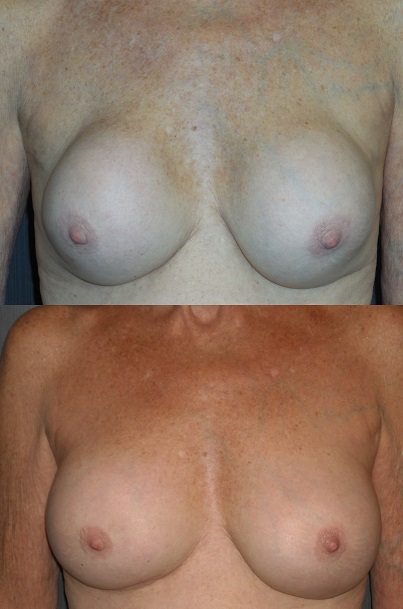
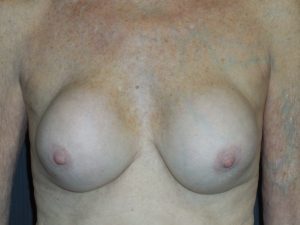
These implants were 41 years old and had a grade 4 capsular contracture. I removed them and the capsule and inserted new implants. She is shown 18 months after surgery.

Once a capsule is well established, surgical intervention is the only way to resolve it.  Complete capsulectomy removes the scar tissue and then the question  is how to prevent a recurrent capsule.  And does it make sense to just pop in another implant right away?  This is just such a difficult question because none of us has a crystal ball to tell the future.  Sometimes capsulectomy and a new implant works great but sometimes another capsular contracture starts forming despite doing everything right.  Sometimes we create a new pocket and make a pocket under the muscle if the over the muscle implant had a capsular contracture and vice versa.  Adding Accolate or Singular makes some sense.  Sometimes adding a piece of acellular dermal matrix like Strattice (which should be spelled  $$$$trattice) will decrease the chance of another capsule.  And whenever there are several different approaches to a difficult problem, you can be sure that none of them works every time.

The only surgery I know of that will for sure prevent another capsular contracture is implant removal and total capsulectomy without implant replacement.  This definitive treatment is readily accepted by many of my older patients who are sick and tired of their nasty, rock hard and uncomfortable implants.  They look forward to being implant free.  For younger patients, however, this can be a very, very difficult thing to accept, especially if they were really, really flat to begin with.  I have at least one patient that comes to mind who had several capsular contracture related surgeries by me and finally we just threw in the towel and removed her implants along with her capsules.  Her breasts returned pretty much to their preoperative size and shape but let me tell you, her wallet was never the same.  A problem with capsular contracture can be very, very expensive and result in a lot of down time – off work, off exercise, off fun.  This particular patient went on to have some fat transfer several years later and did well.  She and I are both glad to have her implant saga behind us.

Just writing this post makes me feel like I never want to do another breast augmentation!  And then I think of the patient I saw in clinic this morning.  She was very, very flat chested and was too lean to consider fat transfer.  I inserted 250 cc low profile cohesive gel implants last week and this morning I could not wipe the smile off her face.  I think as long as there is Victoria’s Secret, there will be a demand for breast augmentation.  I am just grateful that implant technology keeps improving as does our surgical technique.  Hopefully sometime in the near future capsular contracture will be of historical interest only.

Thanks for reading and I would be honored if you followed me on Instagram @sowdermd and @breastimplantsanity.   Dr. Lisa Lynn Sowder

Breast Contouring, Breast Implant Removal, Breast Implants, Plastic Surgery, Uncategorized

Capsular Contracture – the final frontier in breast implant surgery?

April 3rd, 2018 — 10:52am

Capsular Contracture 101

Anyone who knows my practice well knows that I am not a big fan of breast implants.  I much prefer fat transfer and/or breast lift to get a breast looking nicer.  But sometimes only a breast implant will get the patient the size and shape of breasts they desire.  Implants have many issues including malposition (too high, too low, too whatever), size problems (too big or too small), leaking or rupture problems.  Those issues can usually be address with revision surgery.  There is one issue that has tortured plastic surgeons and their patients from day one of breast implants decades ago.  That problem is capsular contracture.

All implants develop a capsule.  Actually it is the body that develops the capsule.  This is normal reaction to a foreign body and, yes, breast implants are a foreign body, a large foreign body.    A capsule only becomes a problem when it become thick and/or tight.  As the capsule thickens or tightens, it puts pressure on the breast implant and turns any shape or profile of implant into a sphere because a sphere is the shape that supports the largest volume in the smallest surface area, or something like that.  Geometry was a while ago for me!  Thus most badly encapsulated implant all look sort of the same – like a ball.  And they all feel hard, sometime really hard and often they are very uncomfortable.  Capsules can even become calcified in which case the implanted breasts are literally rock hard.

Capsular contracture: Looks bad, feels bad.

So what causes capsular contracture?  Good question and I hope the smart researcher who breaks the code wins the Nobel Prize in medicine some day.  A lot of progress has been made, especially in the past 10 years or so and it sure seems like inflammation is the common pathway to capsular contracture.  The most common causes of inflammation around the implant and resultant capsular contracture are 1. bleeding in the implant pocket, 2. subclinical infection and biofilm in the implant pocket, 3. leakage or rupture of silicone gel implants.  Let’s look at these a little closer.

Bleeding in the implant pocket has been known to result in capsular contracture for decades.  Plastic surgeons take a lot of care to really “dry up” the implant pocket prior to inserting an implant.  This is usually done with an electrocautery device call a Bovie.  This little gizmo allows the surgeon to zap little oozing vessels and help prevent any significant blood from accumulating around the implant.  Also, in the rare incidence of post operative bleeding around an implant, surgeons are very quick to take a patient back to the OR to “wash out” the pocket, find and treat the bleeding and reinsert the breast implant.  Sometimes a very minor bleeds can avoid a trip back to the or but in cases like these, the surgeon is on high alert for capsular contracture.

Subclinical infection and biofilm have been on our radar screen for 10 years or so.  Biofilm (which deserves it’s own blog post) is a slimy substance that is produced by certain types of bacteria.  It serves as a protective hiding place for bacteria and is resistant to antibiotics.  The most common example of biofilm is dental plaque.  Yuck.  Anyway, once the biofilm issue became well known, much more attention was paid to reducing the exposure of implants to bacteria.  We are now compulsive about washing out the implant pocket with antibiotic solution, using a no touch technique with a Keller funnel when inserting the implant, changing gloves prior to touching an implant and such.  Remember the billionaire Howard Hughes and his OCD about germs?  Well, we really go totally Howard Hughes with implant surgery!  Also, the location of incision has been shown to have an effect on the rate of capsular contracture.  Incisions around the nipple, through the arm pit or belly button have the highest rates of capsular contracture.   Incisions under the breast (the inframammary fold) have the lowest rate.  This is very likely due to a lower level of bacteria in the area of the inframammary fold as opposed to the other areas.  I use the inframammary fold incision almost exclusively for this reason and also because it allows me to see the pocket really well.

Leakage or rupture of gel implants results the in silicone gel coming into contact with the capsule and this often seems to cause inflammation and hardening or tightening of the implant capsule.  When I am going after a particularly nasty capsule, I expect to see an leaking or ruptured implant and I am usually not disappointed.  The advances made in implant construction – thicker implant shells and more cohesive gel – will hopefully decrease this cause of capsular contracture.

So that is Capsular Contracture 101.  Next up will be a blog about what can be done for capsular contracture.  Stay tuned and thanks for reading.  And I would be honored if you followed me Instagram @sowdermd and @breastimplantsanity.  Dr. Lisa Lynn Sowder


Breast Contouring, Breast Implant Illness, Breast Implant Removal, Breast Implants

Silicone injections are deadlier than ever.

March 13th, 2018 — 2:34pm

Silicone has quietly become beauty’s own modern-day scourge. Here’s what you need to know about the infamous injectable.

From Haper’s Bazaar, January 30, 2018 by Jolene Edgar

We often write about—and unapologetically enjoy receiving—popular cosmetic injections, like line-relaxing Botox and hyaluronic acid fillers. Thankfully for our foreheads and lips, the FDA has deemed these injectables safe and effective. And we trust our board-certified dermatologists and plastic surgeons to administer these treatments 100 percent appropriately.

Marilyn Reed is spending 8 years in prison for her buttock enhancements done with industrial grade silicone and a calking gun. Her patients didn’t get off so easily.

But a disturbing number of news reports have surfaced detailing unlicensed providers injecting all kinds of life-threatening stuff—from industrial silicone to lamb fat—with the goal of Kardashianizing women on the cheap. The FDA issued a safety alert late last year warning the public of the catastrophic risks involved with liquid silicone injections in particular.

All over the country, “people are dying from these shots,” said Beverly Hills liposuction surgeon Aaron Rollins, echoing statements in the FDA alert. Silicone, a permanent synthetic substance, is not FDA-approved for cosmetic purposes, but since it was greenlighted in the 1990s for certain uses in ophthalmology (serious stuff, like retinal detachment), injecting it into the skin to plump and fill lips, breasts, and butts is technically considered “off-label”—i.e. not illegal.

Still, the insidious goo is an infamous troublemaker. “I wouldn’t touch it with a ten-foot pole,” adds Rollins. “It may look good at first, but over time, the body forms scar tissue around it, so the injected area keeps growing and growing, as the silicone weaves its way into your tissues, becoming lumpy and hard, and nearly impossible to remove.”

Subtract an experienced injector from the equation, and silicone goes from dicey to deadly. “You hear about these so-called pumping parties at hotels, where unlicensed doctors visiting from other countries are injecting patients with massive doses of silicone,” says Dr. Clyde Ishii, president of the American Society for Aesthetic Plastic Surgery (ASAPS). “They’re literally buying it from Home Depot or Lowe’s,” he explains, “because it’s so much cheaper and easier to get than medical-grade silicone.” To lower their cost even more, some of these unlicensed doctors mix in toxic filler-type materials, like cement and motor oil, says Miami dermatologist Manjula Jegasothy. “Even in Beverly Hills,” notes Rollins, “there are people using caulk guns to inject stuff into women’s bodies, and tragic things are happening.”

It’s not uncommon for these unlicensed practitioners—inexperienced with human anatomy—to inadvertently shoot silicone into a blood vessel. And when they do, it can travel to the heart or lungs, blocking blood flow, and causing sudden heart attacks and strokes. The risk is especially high when injecting the vascular buttocks. Yet, for some, silicone’s price tag is just too good to pass up. According to Atlanta plastic surgeon Wright Jones, “Silicone butt injections may cost a tenth of the price of a legal gluteal enhancement using one’s own fat”—which is currently regarded as the most effective way to boost a backside. A Brazilian Butt Lift, using liposuction and fat transfer, can cost upwards of $10,000.

In light of the recent wave of silicone horror stories, and with butt augmentation fast becoming one of the most popular plastic surgery procedures in the U.S., not to mention a burgeoning business for untrained injectors, the Aesthetic Surgery Education and Research Foundation (a division of ASAPS) felt compelled to publish a safety protocol for gluteal fat grafting in the current issue of the Aesthetic Surgery Journal.

That’s not to say fat is the only safe solution for a shapeless bottom. Many dermatologists and surgeons do use FDA-approved cosmetic fillers “off-label” here— to either produce an immediate, yet temporary, lift from hyaluronic acid gels; or a gradual, long-term improvement from the collagen-stimulating Sculptra (which is currently only approved to soften the appearance of nasolabial folds). But such shots can be wildly expensive.
Which brings us back to silicone and its unfortunate recipients, many of whom are millennials, says Jones. At age 22, Heather*, a model in Los Angeles, visited a Koreatown medical spa for silicone butt injections. “I was booked to do a big photo shoot, and wanted my bum to look perkier,” she says.

About six months later, she noticed several golf ball-size lumps in her bottom, a common side effect of silicone. On the advice of a trusted friend, Heather says she went to see Rollins, who was able to camouflage the hills and valleys by liposuctioning fat from her arms and injecting it into her butt—an $8,000 fix.

Lips have long been another hot spot for silicone. Tired of having to draw on a juicer pout each morning, Madeline paid $50 to have her lips injected with silicone in a salon basement in Queens when she was 26 years old. Now 40, she says, “I feel like I messed up my mouth for the rest of my life.”

The size and shape of her lips change daily, often with the weather. “Usually in summer [the silicone] lays okay, but in the colder months, it moves around a lot, and concentrates in one area, bulging out.” To have her smile repaired will cost roughly $10,000, she’s been told, and surgeons can’t promise a total improvement.

Cosmetic injections should only be performed by board-certified dermatologists or plastic surgeons. If your injector is not, ask thorough questions about their training and experience. How many years have they been injecting patients? What formula are they using? If you’ve found the injector through a bargain website or coupon—the deal is likely too good to be true. The bottom line: Heed the warnings. “Don’t allow silicone into your body—ever,” says Rollins. At best, “you’ll be buying a problem for the rest of your life.”

Now a word from Dr. Sowder:  The above article is very well written and is not, I repeat, is not alarmist.  People are dying from these injections and others are being maimed for life.  I have taken care of a couple of ladies who had silicone injected into their breasts in Asia and cleaning this up is such a mess.  Whenever I hear about another silicone injection disaster, usually done by a non-physician in some hotel room, I just shake my head.  I mean, really, how dumb can you be?  I do not endorse blaming the victim but in cases like this I think the person allowing a charlatan to inject their butt or breast with silicone bears some responsibility.  Those on the other end of the calking gun need to go to jail and many in fact have.  The lesson here is that you get what you pay for.

Kudos to Ms. Edgar for a cautionary tale and to Harper’s for publishing it.  Thanks for reading and don’t let anyone get near you butt or breast with a calking gun!  Dr. Lisa Lynn Sowder

 

Body Contouring, General Health, Patient Beware, Patient Safety, Plastic Surgery, This Makes Me Cranky.

The surgeon as teacher.

February 25th, 2018 — 12:21pm

This weekend I had the opportunity to participate in a suture lab at Whitman College, a small liberal arts school in Walla Walla, Washington.  This lab is designed for Whitman students who are interested in medical careers. The lab consisted of about 30 students and 7 doctors.  The participating docs included one general surgeon, one plastic surgeon (moi), two OB-Gyns, two ER docs and one family practice doc.  

Now you may be asking what the big deal is in tying a knot and that is a great question.  Proper knots are important in surgery because an improper knot can come untied and the thing the suture was holding together will fall apart.  Not good.  Other activities that require proper knots that come to mind are rock climbing and boating.  Knots need to hold. Also in surgery, it’s important to tie a knot that holds with the least amount of suture material.  Excess suture material can be irritating to living tissue and can also harbor bacteria so you always want to use the knot that is just enough to do the job.

The first part of the lab involved showing the students how to tie two-handed knots and one-handed knots with a length of nylon cord.  I immediately discovered how hard it was to teach a skill that I do without even thinking about  it!  I don’t need my brain because knot tying for me is now in my “muscle memory”, not in my head. It’s the same for many physical skills that involve repetition such as dancing, sports or playing a musical instrument.  And I found that the more I tried to explain it, the harder it was to do.  Fortunately I finally discovered I just needed to shut up and show the students how to do it and they were able to copy my movements.

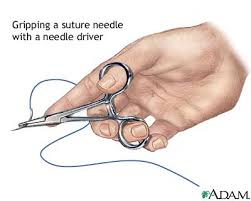
The next part of the lab was showing the students how to suture.  For this we had a nice supply of pig’s feet.  Pig skin is similar to human skin although thicker and tougher.  Suture needles are different than a seamstress needle in that they are curved and require a instrument called a needle driver.   The force required is very different than a simple push.  It’s more of a stoke with a turn of the wrist.  Again, I found explaining it very difficult because it all comes so automatically to me after all of these years.  I was very impressed with the enthusiasm of the students and I think a number of them may very well make fine surgeons.

Another part of this visit included dining with the students in an informal lunch and dinner and answering their many, many questions about being a doctor.  I found it bittersweet to compare my current position with theirs.  I am nearing the end of my surgical career (I’m planning on 5 more years) and they are just at the beginning.  They have so much uncertainty and so many challenges ahead.  Most of that is now in my rear view mirror.  I tried to give them some honest answers and not sugar coat the difficult pathway to becoming a doctor and in particular a surgeon.  I really had a chance to reflect on all of those tough years of medical school and residency and the ongoing challenges of being in practice. I am envious of their youth but honestly would not want to trade places with any of them!

A real bonus for me was the information my 17 year-old daughter, who came with me,  received from these bright college students.  She is at the beginning of her college search and she got some great advice about choosing a college.  And she got a nice tour of Whitman.

I am hoping I get invited back again to teach another batch pre-med students a few tricks of the trade. And who knows, one of those students may be my daughter!

Thanks for reading.  Dr. Lisa Lynn Sowder

I would be honored if you followed my on Instagram @sowdermd and @breastimplantsanity.


Surgical Eductaion

Ten common misconceptions about liposuction

January 30th, 2018 — 9:33am

If you look like this, you don’t need liposuction!

Taken from an article by Dr. Wayne Carman for online American Society of Plastic Surgeons from January 30, 2108

Liposuction is one of the most frequently performed cosmetic surgical procedures in the United States and around the world. This is somewhat surprising, considering how many misunderstandings about it persist. Listed below are the ten most common liposuction misconceptions we hear as plastic surgeons, and what the actual facts are.

Liposuction can help you lose weight

The reality is that most patients only lose about two to five pounds in total. The best candidates, in fact, are generally within 30 percent of a healthy weight range and have localized fat pockets they would like to reduce.

Liposuction can treat cellulite

Cellulite is not simply an irregular pocket of fat – it occurs when subcutaneous fat pushes connective tissue bands beneath the skin, causing those characteristic dimples and bumps. Because liposuction is only able to remove soft, fatty tissue (and does not directly affect the skin or other tissues), the fibrous connecting bands causing cellulite are not altered.

Liposuction is not for “older” people

Any patient who is in good health and has had a positive medical examination may safely receive liposuction. A lack of firmness and elasticity (both of which commonly decrease with age) may compromise the skin’s ability to re-drape over newly slimmed, reshaped contours. Poor skin quality is one of the main contraindications to liposuction.

Liposuction is dangerous

While every surgery carries an element of risk, liposuction techniques have become increasingly sophisticated. If performed by an experienced and board-certified plastic surgeon, and if the patient follows all appropriate postsurgical instructions, liposuction can be as safe and successful as any other surgical procedure.

Liposuction will fix lax skin

The appearance of a double chin or a heavy tummy may involve some degree of sagging skin with reduced elasticity, as well as excess fat. In such cases, your surgeon may recommend a skin tightening procedure instead of (or in conjunction with) liposuction, as liposuction alone may result in a deflated appearance.

Fat deposits removed will return after liposuction

Liposuction is “permanent,” in that once the fat cells are suctioned out, they will not grow back. However, there will still be some remaining fat cells that can grow in size and expand the area if one’s calorie intact is excessive. The best way to prevent this is to maintain a healthy diet and exercise regimen.

Liposuction is the “easy way out”

As mentioned earlier, liposuction is not a weight loss method, and maintaining ideal postsurgical results should include a general commitment to a healthy lifestyle. Liposuction (or any other body contouring method, for that matter) is targeted to streamline and contour localized areas – ideally, in someone who is within a healthy weight range.

You can get back to your routine right after liposuction

While relatively safe and frequently performed on an outpatient basis, every surgical procedure entails a recovery period, and liposuction is no exception. The most common after-effects include swelling, bruising, and soreness at and around the treatment areas. While the healing process varies from patient to patient, most should plan to take at least a week off work to rest and recover. It may be four to six weeks before a patient can resume strenuous activity or exercise.

Liposuction is only for women

Men frequently request liposuction – in fact, it was one of the top five most popular cosmetic surgeries American men received this past year, according to ASPS statistics. Common areas for treatment include the abdomen, love handles and chest.

Liposuction is always the answer to belly fat

Liposuction targets only subcutaneous fat – the kind that is located below the skin and above the muscle. An abdomen that protrudes due to fat under the muscle and around the internal organs (known as visceral or intra-abdominal fat) will not be improved with liposuction. Appropriate exercise and diet are the only effective methods to combat visceral fat.

Thanks for reading.  Follow me on Instagram @sowdermd and @breastimplantsanity.

Dr. Lisa Lynn Sowder.

Body Contouring, Liposuction

« Previous Entries     Next Entries »

↑ Back to top

Contact Dr. Sowder

Blog Topics

  • Acne
  • Aging Issues
  • Body Contouring
  • Botox
  • Breast Contouring
  • Breast Implant Illness
  • Breast Implant Removal
  • Breast Implants
  • Breast Lift
  • Breast Reduction
  • Children
  • Earlobes
  • Facial Fillers
  • Facial Rejuvenation
  • Fat Injection
  • Fat Transfer to the Breast
  • Financial Issues
  • For Men Only
  • Gardening
  • General Health
  • Government and Politics
  • Gynecomastia
  • Hand Surgery
  • Health Care Costs
  • Highly Recommended Reading
  • Hyperhidrosis
  • I Love Seattle!
  • Ineffective
  • Irish Step Dancing
  • It's All About Me.
  • Labiaplasty
  • Laser Liposuction
  • Lip Enhancement and Augmentation
  • Liposuction
  • Male Plastic Surgery
  • Mommy Makeover
  • My Plastic Surgery Philosophy
  • Nasolabial Folds
  • New Technology
  • Nipples
  • Non-invasive
  • Now That's a Little Weird
  • Now That's Cool
  • Obesity
  • Patient Beware
  • Patient Safety
  • Plastic Surgery
  • Postoperative Care
  • Preoperative Care
  • Scar
  • Skin Cancer
  • Skin Care
  • Stuff I love
  • sun damage
  • Surgical Eductaion
  • This Makes Me Cranky.
  • Trauma
  • Tummy Tuck
  • Uncategorized
  • Wardrobe Observations
@lisalynnsowder
@sowdermd
@breastimplantsanity
© Lisa Sowder MD, FACS 2026. All rights reserved. Contact Dr. Sowder. Credits. Login.